
Once upon a time, there was a sad, sad kitchen, likely designed around 1980.
Tragically, it was MY kitchen.

It had sticky oak cabinets, salmon colored Formica countertops, and a trashed wood floor. The wall cabinets were short. The under-cabinet lighting gave up long ago. To add insult to injury, there was only 13″ between the countertops and the bottom of the cabinets. (There should be 18″.)

When we first moved in (nearly 12 years ago), I refused to do anything to the space — even paint — because we were going to renovate the kitchen immediately, if not sooner.

The back porch even conveniently quasi-collapsed in 2012, which I hoped would FORCE us into a kitchen renovation…but it didn’t, quite…
Anyway, over time, we replaced the dishwasher. I bought it sight unseen, the cheapest available, because, well, we were going to renovate any minute, and I was sure I’d want a nicer one at that point.
HA! again.
We also replaced the range under duress one Thanksgiving with an overpriced, horrible Jenn-Air that cost $650 every time it had to be repaired. Which was more than once. By the end, you couldn’t press the 0 on the keypad, so if you wanted to preheat the oven to 350 degrees, you’d have to outsmart it and type 351. Or 349.
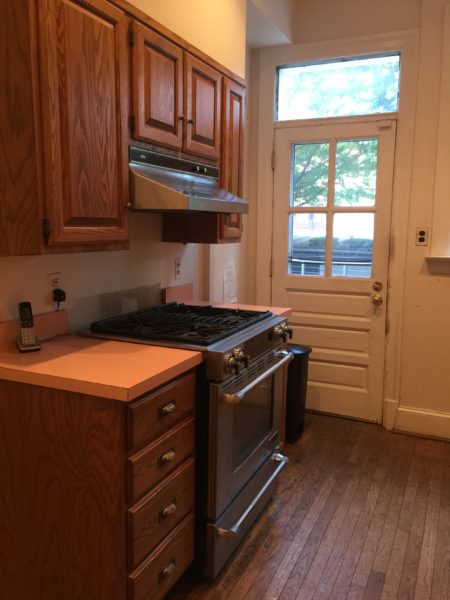
You know what damaged the keypad? Windex. So I guess you were just supposed to let the grime build up until you couldn’t even see the numbers anymore. I hate Jenn-Air.
Here’s what the kitchen had going for it:
- Southern exposure
- Workable footprint — appliances were generally in the right places
- And…
Nope. That’s it.
In spite of all the cosmetic offenses, my biggest complaint about this kitchen was that it didn’t have a place where our family of four could eat.
Let me back up: we live in a Wardman townhouse in Woodley Park, which I love, love, love. It’s just the right size for us: I believe in using every single space in a house, which we absolutely do. I’ve been very happy to eat all dinners and weekend lunches in the dining room, which is mere steps away.
But breakfast. Even at “mere steps away,” the dining room is just a tad far and a tad formal for hasty weekday breakfasts. So on a typical morning, John and I stumble into each other while the girls wolf down their Cheerios at the little table the previous owners (our friends) left for us. I don’t think I’ve ever eaten breakfast sitting down, now that I think about it. It sure would be nice to have a place where, theoretically, we all could sit and eat in the kitchen.
I also have fantasies of our daughters doing their homework in the kitchen while I whip up an easy, nutritious, delectable weeknight dinner. (Note to self: identify such a dinner and then learn how to make it.)
To get an eat-in kitchen, we had one of two choices: stick with the current footprint, or expand, building out onto the back porch/deck.
Without expanding, we might be able to configure one end of the kitchen into a eating area with a banquette and a small table.

That would enable us to build a coat closet at the foyer end of the kitchen. We’d effectively build a wall say, between the bookcase and the table in the picture above. And the door, which now connects the foyer to the kitchen, would open into a fantastic coat closet from the foyer. So that end of the kitchen would shrink — a little tricky since the door to the basement is right there — but I was betting we could work it out.
Here’s the fantasy. Note the things this picture has that we do not: windows, elbow room…

Advantages of working within kitchen’s current footprint:
- We’d gain a coat closet
- It would be less expensive than expanding
- A new, still-small kitchen would be better than the crappier-than-crap kitchen we have now
Disadvantages of staying the same size:
- We’d gain little to no storage space
- We’d block the flow. We’d reduce the entrances to the kitchen to one: you’d have to walk through the living and dining rooms to enter the kitchen. Not a huge deal except when we’re throwing a party, when circulation is key
- The eating area would be tight. Very tight
So naturally, we decided to go with the more expensive option: expansion.
Stay tuned, Gentle Readers. The fun is just beginning.
Bossy color | Annie Elliott interiors is based in Washington, D.C. We create outrageously beautiful homes, starting with color.